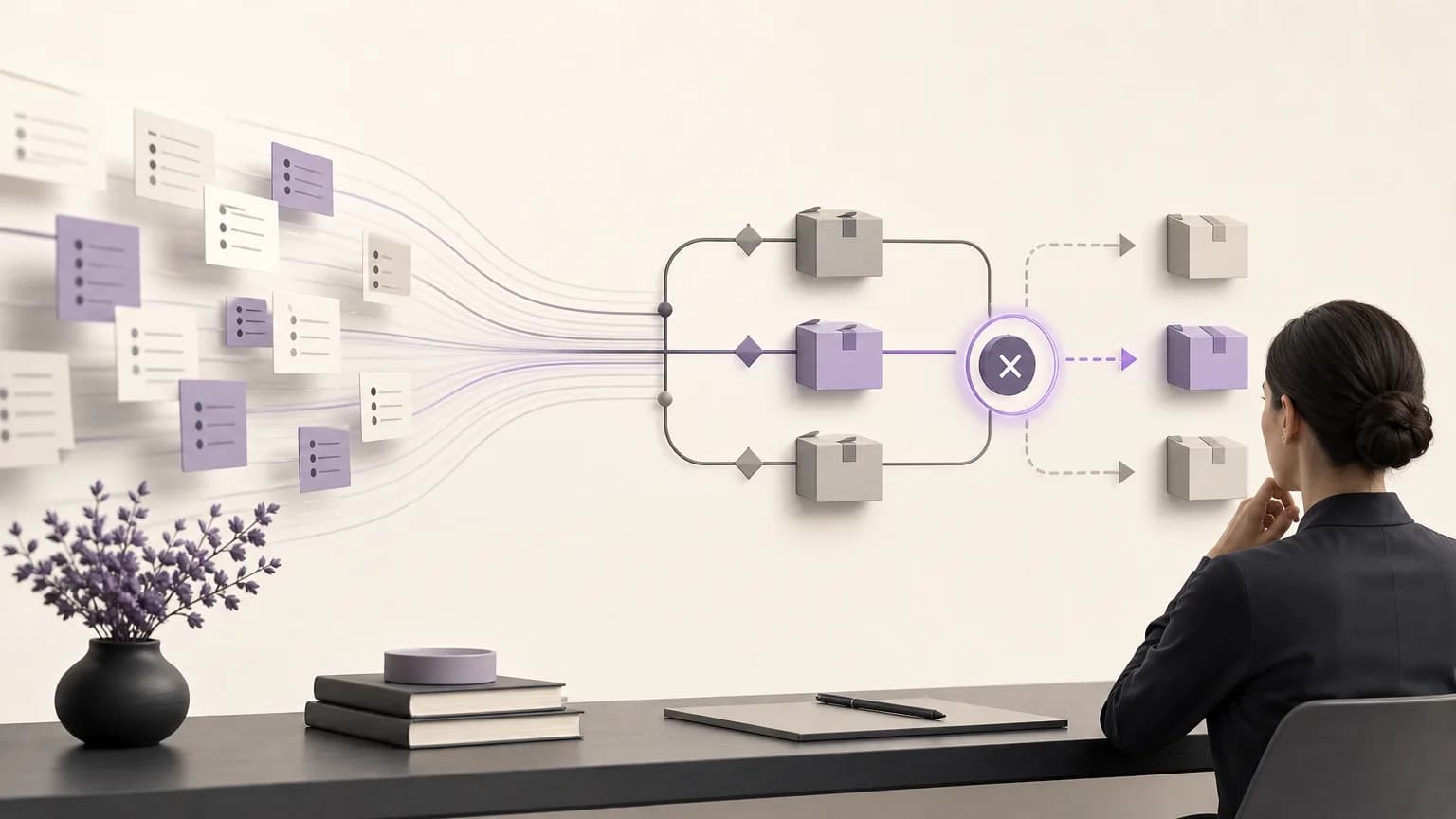
A cancelled order is not only the end of a sale. It is also an operational record that can help sales and operations teams decide where verification or follow-up deserves attention. The useful question is not simply how many orders were cancelled, but what the available record shows: when the cancellation occurred, which branch handled the order, which item was involved, and what order status was recorded at the time.
OrdertechERP connects sales, orders, inventory, accounting, reporting, and branches in one operating workspace. This gives teams a shared place to review a cancelled order in context rather than reconstructing the story from separate files or conversations. The quality of the review still depends on data quality, company configuration, team permissions, and whether the required details were recorded in the first place.
Start with the record, not a theory
Cancellation review is more reliable when the team separates recorded facts from possible explanations. Cancellation time, branch, item, and available order status are observable starting points. A cause such as delivery delay, unavailable inventory, or a change of customer preference should not be treated as fact unless it is recorded or confirmed through the company’s approved process.
This distinction prevents a visible pattern from becoming an unsupported conclusion. Several cancellations involving one item do not prove that the item caused them. A concentration in one branch does not prove a branch-level problem before the available details have been checked. The purpose of the review is to identify what should be verified next, not to assign blame from incomplete evidence.
Use a consistent review method
Before reviewing a period, sales and operations should agree on the fields they will inspect for every cancelled order. The following checklist can provide a shared operating baseline:
- Cancellation timing: Check whether the order was cancelled soon after entry or after it reached another status available in the system.
- Branch: Compare cases across branches for the same period, while considering differences in order volume and operating conditions.
- Item: Look for repeated appearances of an item or item group without treating repetition as proof of cause.
- Order status: Use the recorded status to understand how far the order had progressed before cancellation, based on company configuration.
- Notes and available data: Check whether the record contains supporting information. Do not add an unrecorded explanation as if it were confirmed.
A consistent method makes reviews easier to compare across branches and periods. It also reduces the need to request the same information from multiple teams.
Turn observations into priorities
Every cancelled order does not require the same response. Once the records have been reviewed, cases can be prioritized using criteria defined by the company and permitted by team roles. Higher priority may go to repeated cases within a short period, orders cancelled after reaching a later recorded status, or cases that require an inventory or sales follow-up.
Prioritization is not a verdict on a branch or employee. It is a way to direct limited review time where it may be most useful. A practical structure is to place cases into three working queues:
- Quick verification: Cases where the team needs to confirm that the available data is complete or consistent.
- Operational follow-up: Cases that may require contact with the responsible team, where the relevant permission and approved process exist.
- Routine monitoring: Cases that do not require immediate action but should remain visible for a later trend review.
Document the rule for moving a case from one queue to another. Otherwise, priorities can change depending on who performs the review. A visible pattern should also remain a prompt for verification, not an automatic final decision.
Coordinate around the same order
Cancellation review works best when responsibilities are clear. Sales can review the order details and any permitted follow-up path. Operations can examine cancellation timing, recorded status, and differences between branches. Inventory can check relevant availability or movement data when those data are available within the company’s configuration and permissions. Accounting and reporting teams can review the information relevant to records and reporting without reinterpreting it beyond the company’s defined process.
When these teams work from one operating workspace, they can return to a shared order record and reduce manual copying between systems or files. OrdertechERP’s AI operational assistant can help connect an order and its data to a next step according to the company’s setup and team permissions. It does not replace record review, prove a cancellation reason, or bypass access controls.
Verification questions before acting
Before contacting a branch or changing an operating step, ask focused questions:
- Are the cancellation time and the preceding recorded status available?
- Does the pattern appear in one branch or across several branches?
- Is the repetition linked to a particular item, or could it reflect that item’s higher order volume?
- Is there a supporting note or data point, or is the explanation only an assumption?
- Who has permission to verify, follow up, or update the relevant information?
- Can the next step be performed under the current setup, or does it require approval or a change in the operating method?
These questions keep the review disciplined and reduce the risk of holding a team or branch responsible for something the record does not establish.
Review process quality, not only cancellation counts
Set a recurring cancellation review appropriate to the company’s volume and operating model. In each cycle, check whether important fields are recorded consistently, whether teams know who owns verification, and whether priority cases are closed with a documented action. Period-to-period or branch-to-branch comparisons can be useful, provided differences in order volume and operating configuration are considered.
If the review shows that an important reason is rarely recorded, the issue may be data completeness rather than the performance of a particular team. The practical response is then to review the recording process, configuration, and permissions—not to invent a reason from an incomplete pattern.
Conclusion
Cancelled orders give sales and operations teams a structured opportunity to see where and when verification may be needed. Start with the available record for timing, branch, item, and status. Then prioritize cases using clear criteria and defined permissions, while keeping recorded facts separate from assumptions. OrdertechERP brings sales, orders, inventory, accounting, reporting, and branches into one operating workspace. Its AI operational assistant can connect order data to a next step within the company’s configuration and team permissions. The value of the review still depends on data quality, setup, and disciplined execution: these tools support better decisions, but they do not replace professional verification.